Is More Money in Your 401(k) Always Better?
You've heard the advice a hundred times: max out your 401(k). And it's good advice — most Americans save far too little for retirement. But here's a question almost nobody asks: can you have too much in your 401(k)?
The answer is yes — or at least, a giant pre-tax balance can create tax headaches you never expected. That's because a 401(k) is tax-deferred, not tax-free. Every dollar you put in pre-tax (plus all of its growth) will be taxed as ordinary income when it comes out. Save enough, and the IRS makes sure it comes out — on their schedule, not yours.
Let's walk through what actually happens.

1. The tax bill always comes due
Meet David, age 73, who did everything right. (David is an illustrative example.) Decades of maxing out his 401(k), plus employer matching, have grown his balance to $2 million. He doesn't need that much to live on — but the IRS doesn't care. At 73, his required minimum distribution is roughly $2,000,000 ÷ 26.5 ≈ $75,000 for the year. That $75,000 stacks on top of his Social Security and any other income, and every dollar is taxed as ordinary income.
A few ways a large balance can quietly cost you:
Bracket creep. Required minimum distributions (RMDs) grow as you age because the IRS life-expectancy divisor shrinks. At 80, that balance forces out roughly $99,000 a year; at 90, about $164,000 — whether you need the money or not.
Medicare surcharges (IRMAA). Your Medicare Part B and D premiums are set from your income two years earlier. One big RMD year can trigger monthly surcharges that linger for a full year.
More of your Social Security gets taxed. Once your "combined income" passes thresholds that aren't indexed for inflation, up to 85% of your Social Security benefits become taxable.
The widow's penalty. When one spouse dies, the survivor files as single — with tax brackets roughly half as wide — while the RMDs stay about the same size. Same income, noticeably more tax.
None of this means saving was a mistake. It means the exit needs a plan, not just the entrance.
At this point, you might be thinking: fine — then I'll just leave the money alone and pass whatever's left to my kids. Can I do that?
Not exactly. Before inheritance even enters the picture, there's a more immediate problem: once you reach a certain age, the IRS won't let you just sit on a big pre-tax balance. You have to start withdrawing — whether you need the money or not.
2. RMDs: the IRS's withdrawal schedule
Required minimum distributions are the mechanism that forces money out of tax-deferred accounts:
When they start. Born 1951–1959: age 73. Born 1960 or later: age 75. (Born 1950 or earlier: it was 72.)
How they're calculated. Take your account balance on December 31 of the prior year and divide by a life-expectancy factor from the IRS Uniform Lifetime Table — 26.5 at age 73, 20.2 at 80, 12.2 at 90.
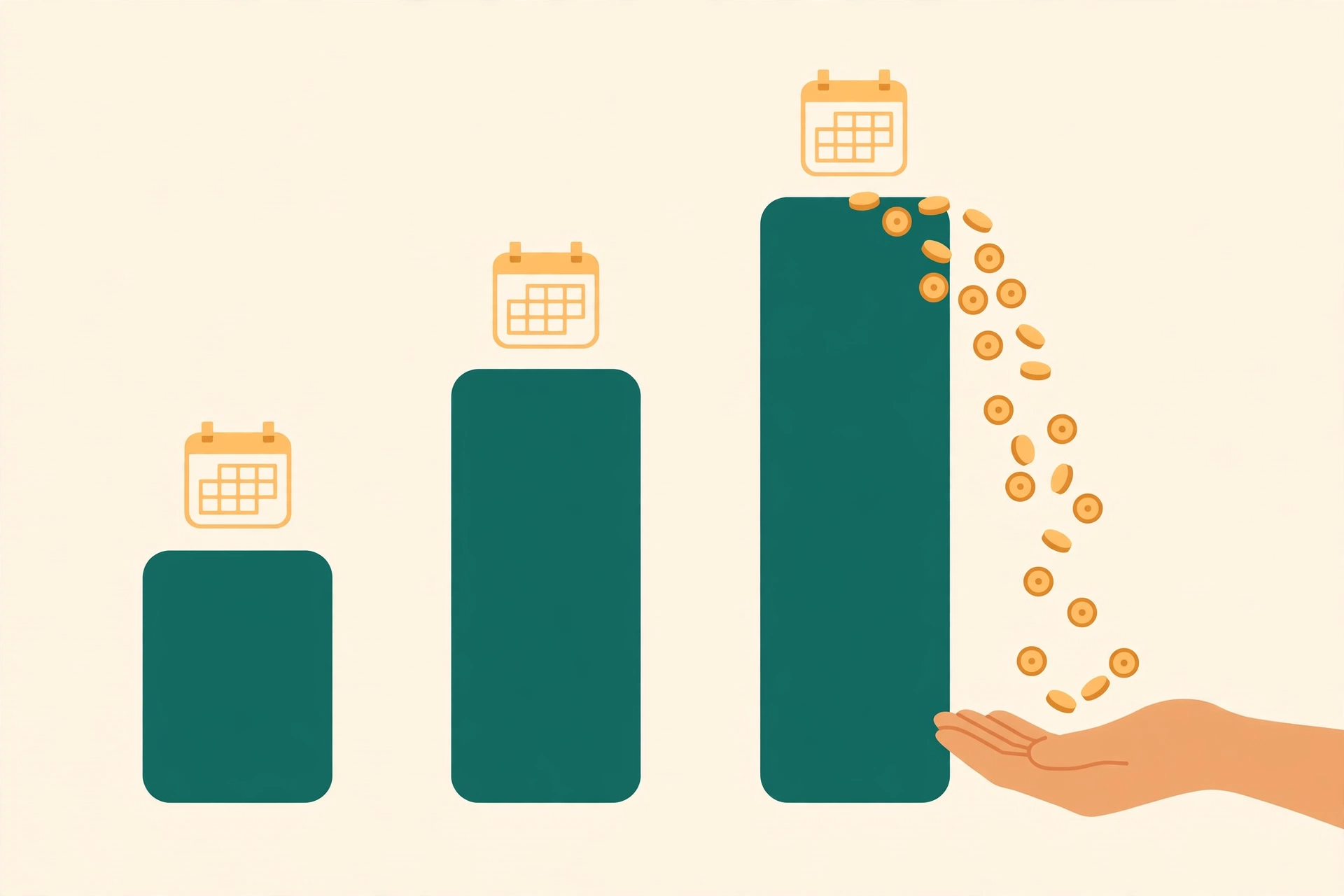
Deadlines. Your first RMD can wait until April 1 of the year after you reach the starting age — but then you'd take two RMDs in one tax year, so most people just take it by December 31. Every year after, the deadline is December 31.
The penalty for skipping. Miss an RMD and the IRS can charge 25% of the amount you should have withdrawn (10% if you correct it promptly). Before SECURE 2.0, it was 50%.
Still working? If you're still employed and own no more than 5% of the company, you can delay RMDs from your current employer's plan until you retire. This doesn't apply to IRAs or 401(k)s from previous jobs.
So RMDs force your hand while you're alive. But what about after you're gone — can your spouse or kids at least stretch the withdrawals out slowly?
Only partly. The tax code puts a forced time window on inherited 401(k) money too. For most non-spouse beneficiaries, that window is just ten years — which can bunch large taxable withdrawals into your kids' peak earning years and trigger even more tax than you faced.
3. What happens to your 401(k) when you die
Your 401(k) doesn't go through your will — it goes to whoever you named as beneficiary. That's why keeping that designation updated after marriage, divorce, or kids matters so much: the beneficiary form beats the will, every time.
If your spouse inherits. They get the most options: roll it into their own IRA and treat it as theirs (RMDs on their own schedule), keep it as an inherited account and delay withdrawals until you would have reached RMD age, or in some cases follow the 10-year rule below. One underappreciated perk: a spouse under 59½ who inherits can take money from the inherited account without the usual 10% early-withdrawal penalty.
If your kids — or anyone else — inherit. Under the SECURE Act, most non-spouse beneficiaries must empty the account by the end of the 10th year after your death (the "10-year rule"). If you died after RMDs had already begun, they generally must also take a minimum amount each year during those 10 years. The withdrawals are taxed as ordinary income to them — potentially landing a big tax bill right in their peak earning years.
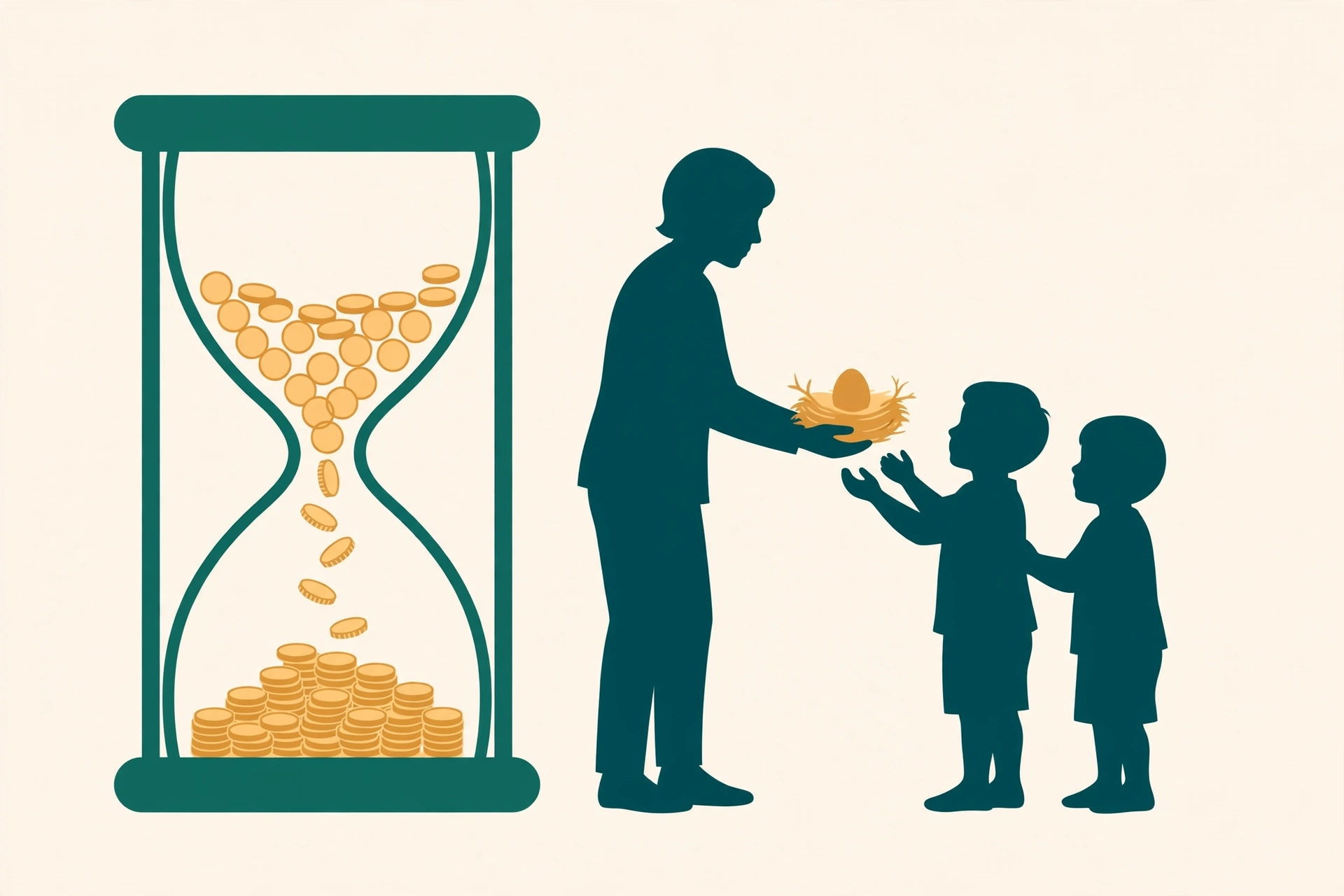
Exceptions that can stretch longer. Your minor child, someone who is disabled or chronically ill, or someone not more than 10 years younger than you may take distributions over their life expectancy instead. (For a minor child, the 10-year clock starts once they reach adulthood.)
If no person is named. The account can end up in your estate, which typically means the fastest, least flexible payout schedule — the worst tax outcome of all.
One more note: beneficiaries owe ordinary income tax on pre-tax 401(k) money they receive. Inherited Roth 401(k) money is generally income-tax-free as long as the 5-year holding rule is met.
4. Left a job with a small balance? Your old employer can force you out
This one surprises people. If you leave a job and your vested 401(k) balance is $7,000 or less, your former employer is allowed to force a distribution — they don't have to service a tiny account forever. (Congress raised this limit from $5,000 to $7,000 in 2024.)
$1,001–$7,000: if you don't tell the plan what to do, it will automatically roll your money into an IRA in your name. You keep the tax deferral, but now it's sitting in some default IRA you didn't choose — easy to lose track of.
$1,000 or less: the plan can simply mail you a check. Cash it, and it's taxed as ordinary income plus 20% federal withholding — and a 10% penalty if you're under 59½.
The move: when you leave a job, proactively roll the old 401(k) into your new employer's plan or an IRA you chose yourself. Don't let a forced cash-out — or a forgotten auto-rollover IRA — happen by default.
5. So what should you actually do about it?
First: don't stop contributing — especially up to the employer match. Turning down the match is turning down a 50–100% instant return, and no tax planning beats that.
The real answer to "too much 401(k)" is tax diversification plus exit planning:
Mix pre-tax and Roth. Pre-tax saves you taxes today; Roth buys you tax-free withdrawals later. Having both gives you dials to turn in retirement.
Use low-income "gap years." The years between early retirement and RMDs/Social Security are often your lowest-tax years ever — a prime window to convert pre-tax dollars to Roth at a lower rate.
Give from your IRA with qualified charitable distributions (QCDs) — if giving is already part of your plan. At 70½ or older, you can send up to $111,000 per year (2026 limit, indexed for inflation) directly from an IRA to charity. It counts toward your RMD and never shows up in your taxable income. A QCD only helps if you were going to donate anyway — it's money you give away, not money you keep — but for charitably inclined retirees, it's one of the most tax-efficient ways to handle an RMD they don't need to spend.
Keep beneficiaries current. Review them after every major life event — marriage, divorce, new child.
The bottom line
For the vast majority of people, "too much in my 401(k)" is a wonderful problem to have — it means the saving habit worked. The mistake isn't contributing too much; it's assuming the job is done once the money is in. The tax bill was always deferred, never forgiven. Plan the withdrawal with the same care you planned the contribution, and you'll keep far more of what you saved.
Disclaimer: This article is for general educational purposes only and is not tax or financial advice. Tax rules change; consult a qualified tax professional about your situation.
Sources & further reading
- IRS: Retirement plan and IRA required minimum distributions FAQs — RMD ages, deadlines, the 25% (10% if corrected) excise tax for missed RMDs, and the 10-year rule for beneficiaries.
- IRS Publication 590-B, Distributions from Individual Retirement Arrangements (IRAs) — how RMDs are calculated (Uniform Lifetime Table).
- U.S. Congress: SECURE 2.0 Act of 2022 (Division T of P.L. 117-328) — the law behind the RMD age change (73/75), the $7,000 small-balance force-out rule (§304), and the end of RMDs for Roth 401(k)s (§325).
The 2026 QCD limit of $111,000 per person reflects IRS inflation adjustments (Notice 2025-67).
#401k #RMD #RequiredMinimumDistribution #RetirementPlanning #TaxPlanning #Beneficiary #SECUREAct #RothConversion #QCD
Get new guides by email
One email when a new guide is published. Plain-English benefits explainers — no spam, no selling your address. Unsubscribe anytime.
By subscribing you agree to receive email updates from Everyday Benefits. Unsubscribe anytime with one click.