Where Will Your Retirement Income Come From?
The one-sentence version
When you stop working, your income usually comes from three places: Social Security, a retirement plan from your employer, and your own savings. Picture them as three legs of a stool — if one leg is short, the whole thing wobbles.
Maria thought one leg was enough
Maria's story is an illustrative example.
Maria is 58. For 22 years she has worked the front desk at a dental office — steady job, steady paycheck. Every open enrollment, HR slides a 401(k) packet across the table. Every year, Maria sets it aside: "I'll deal with it later. Social Security will cover me."
Last month, her coworker retired at 62 and started collecting Social Security early. Over lunch she mentioned the monthly amount — and Maria did quick math on a napkin. Her own estimated benefit would cover barely half of her monthly bills. "Later," she realized, "is now."
Maria's story isn't rare. It's what happens when you plan a retirement on one leg of a three-legged stool.
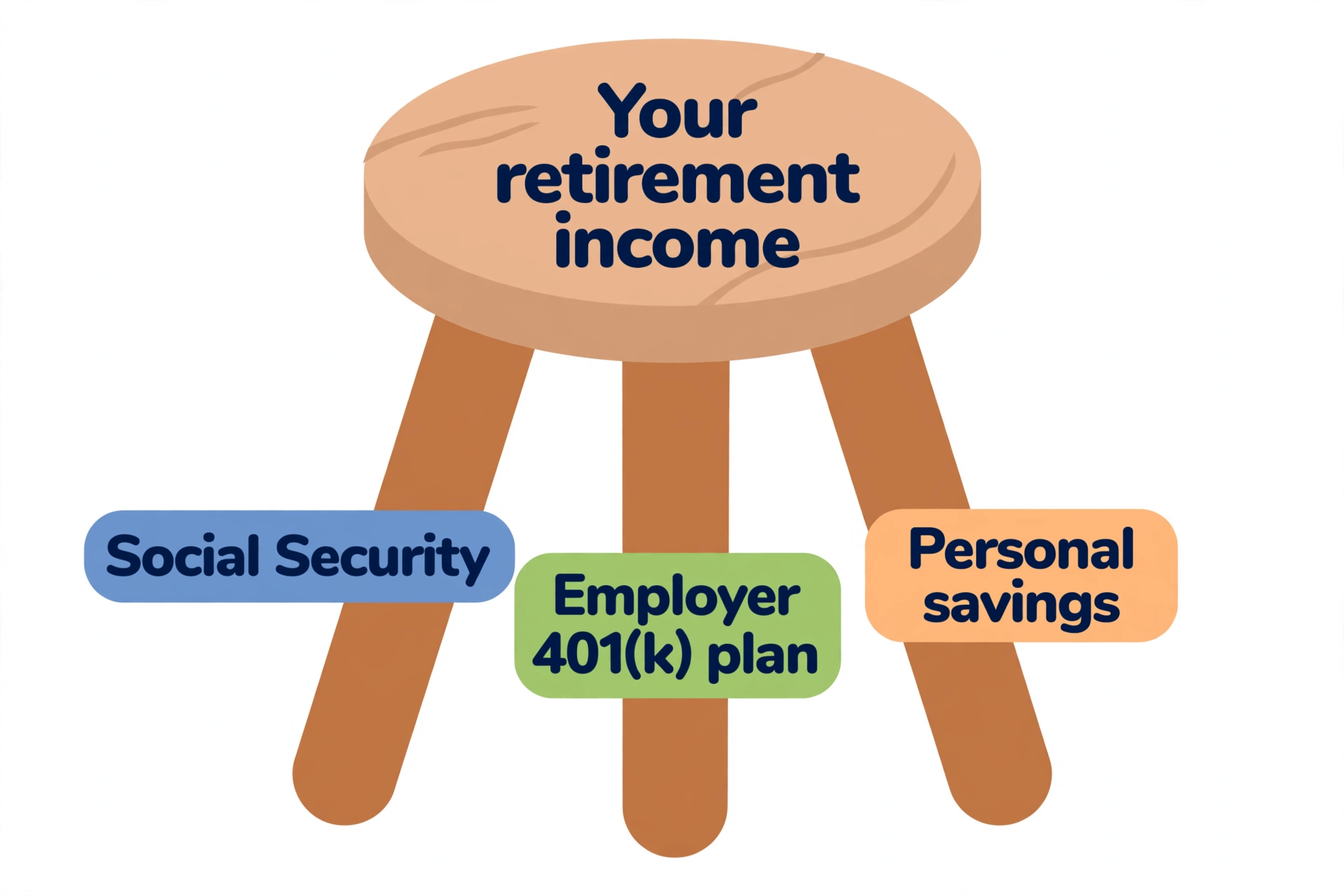
Leg 1: Social Security — the foundation, not the whole house
Social Security is the government program you pay into with every paycheck. (See "FICA" on your pay stub? That's it — you and your employer each contribute.)
Here's the part most people miss: on average, Social Security replaces about 40% of a worker's pre-retirement earnings — not 100%. Think of it as the foundation of a house: essential, but nobody lives on a foundation alone.
One more thing worth knowing: the longer you wait to claim (up to age 70), the bigger your monthly check. Claiming early shrinks it permanently. We'll dig into timing in a future article.
Leg 2: Your employer's retirement plan — part of your pay, paid to future-you
If your job offers a 401(k) — or a 403(b), 457, or similar plan — that's leg two. And here's a reframe worth real money: retirement benefits are part of your wage package. Economists even have a name for it, the "deferred wage" idea: it's your pay, just delivered to future-you instead of in today's paycheck.
That reframes the employer match, too. When a company matches your contributions, that's not a gift — it's compensation. Skipping it is like voluntarily taking a pay cut.
The tax part, in plain words: money goes into the plan before income tax, which lowers the income you're taxed on today. It grows without a yearly tax bill. You pay tax when you withdraw in retirement — often when you're in a lower tax bracket.
Also good to know: many employers now enroll you automatically (a recent law, SECURE 2.0, pushed this). Auto-enrolled doesn't mean fully funded, though — check your contribution rate.
Leg 3: Your own savings — the leg you fully control
IRAs, investment accounts, plain savings — anything outside work. No employer required, no permission needed.
This leg matters for two reasons: it's portable (it follows you through every job change), and it fills whatever gaps the other two legs leave. It's also the only leg that's 100% in your hands from day one.
Why so many stools wobble today
Three trends from the history books, translated:
- We live much longer. U.S. life expectancy was 47 in 1900; it reached a record 79 in 2024, according to the CDC. That's decades more of retirement to fund.
- Retirement isn't as cheap as people assume. Health care and long-term care costs climb, and most retirees don't actually spend much less — travel, hobbies, and grandkids cost money.
- Personal savings haven't kept up. As costs rose and credit got easy, the share people save on their own drifted down.
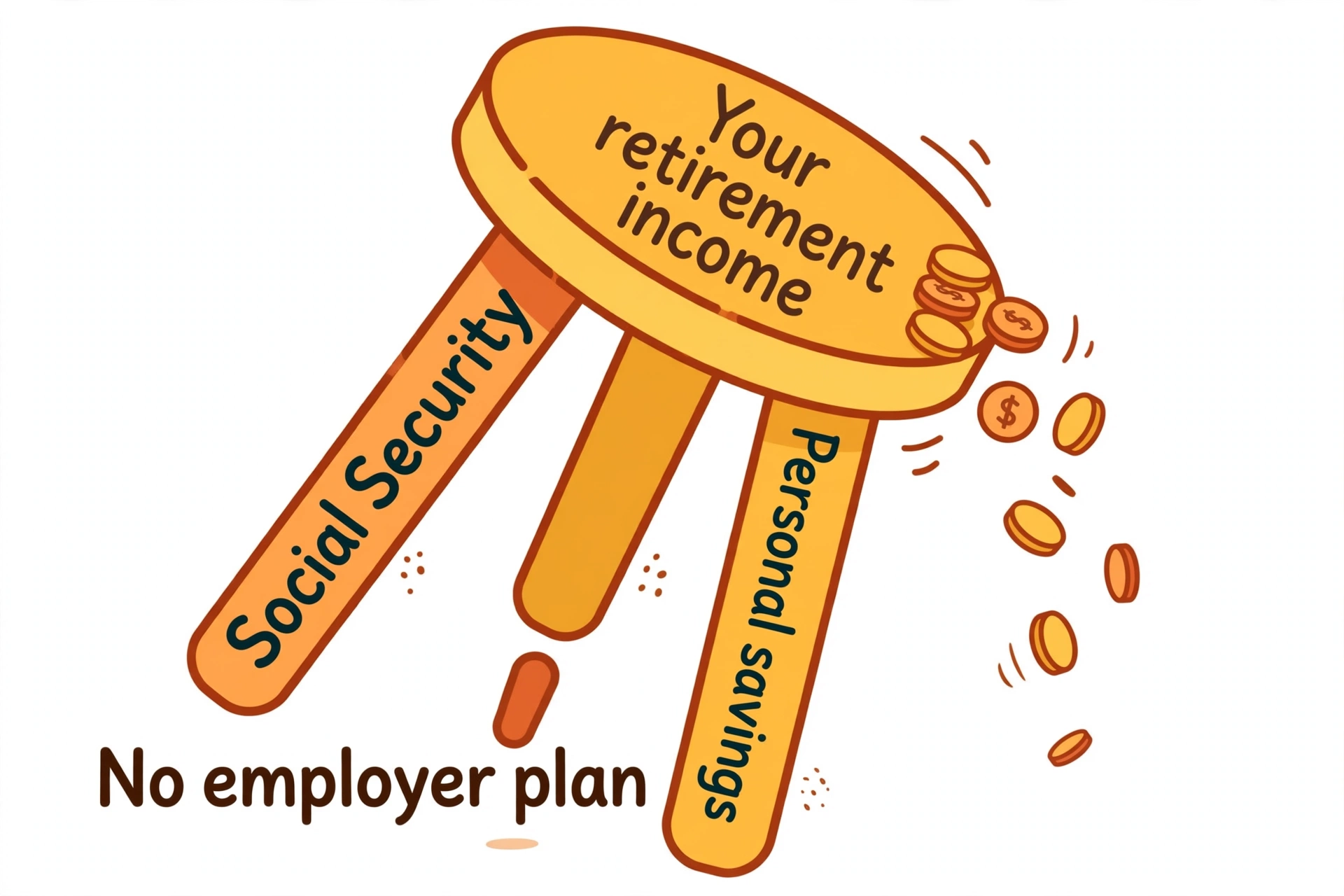
Three things you can do this month
- Check your employer's plan — and grab the full match. Find out if your job offers a retirement plan, and contribute at least enough to capture the entire employer match. Not sure what the match is worth? Run your numbers in our 401(k) match calculator.
- Look at your Social Security estimate. Create an account at ssa.gov and find your estimated benefit. Hold that number next to your monthly spending and see the gap with your own eyes.
- Automate one small transfer. Move even $50 a month into your own savings automatically. The leg you control is the one that never needs anyone's permission.
#ThreeLeggedStool #SocialSecurity #401k #EmployerMatch #RetirementBasics
This is educational content, not financial advice. Rules and limits change — always check your plan documents or ask your HR team for your specific details.
Get new guides by email
One email when a new guide is published. Plain-English benefits explainers — no spam, no selling your address. Unsubscribe anytime.
By subscribing you agree to receive email updates from Everyday Benefits. Unsubscribe anytime with one click.